


Overview:
The Trump administration's attacks on LGBTQ+ rights have made this year's PrideFest events feel more like Pride's politically charged roots.
Though he is now in his 70s, longtime Denver resident Frankie Seibert still looks forward to going to Pride with his partner every June. Seibert, who is gay, moved to Denver in 1971 to study in the seminary—he attended his first Pride celebration in 1979 and has been going ever since, though now he and his friends prefer the parade to the tightly packed PrideFest.
“It’s fun to go to, but it’s also, I need to be seen and I need to know people know how I feel,” Seibert said. “(Evangelical conservatives) tell me I can’t live my life, and they tell trans people they can’t live their lives, and they tell lesbians they can’t live their lives. I am a human being that has rights, and I get angry that they think that their God can tell us what to do, and therefore, they can tell us what to do.”
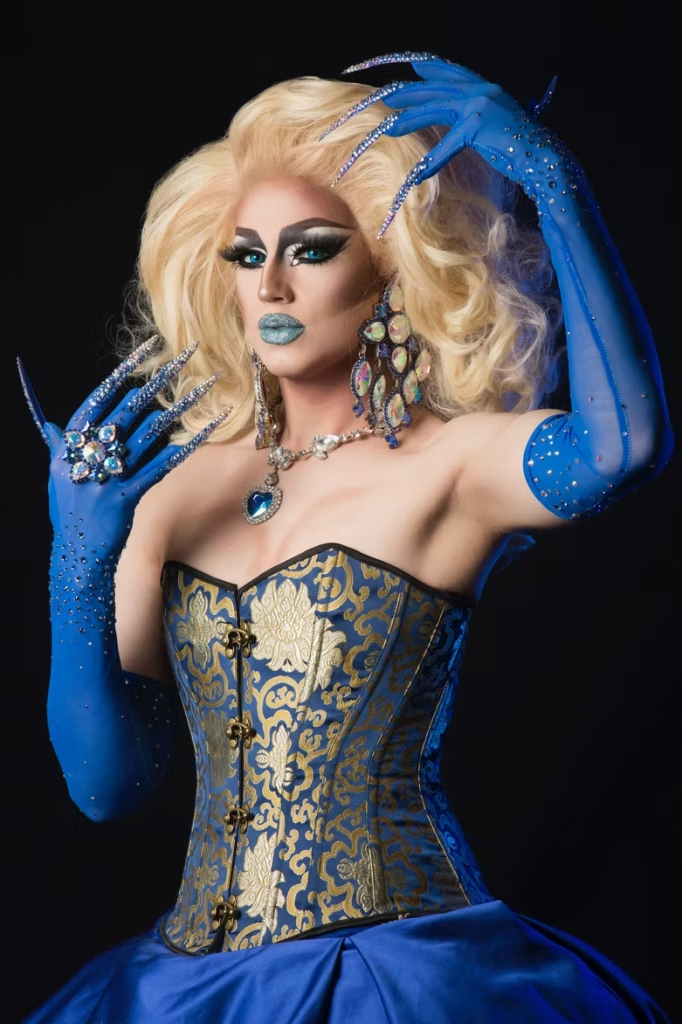
Hosted by the Center on Colfax, Denver’s PrideFest is the fifth-largest Pride celebration in the country. This year, the two-day festival will feature performances by a host of drag performers and DJs, including headliners Pattie Gonia, Detox, Miss Vanjie and CHIKA, as well as more than 250 vendors, 30 food trucks, a Pride parade and a Pride-themed 5k race.
Due to rollbacks of federal funding for DEI-related events and anti-DEI executive orders, new CEO Kim Salvaggio said this year’s festival initially saw a significant drop in corporate sponsorship—at one point, the Center was about $200,000 short of its fundraising goal, which it declined to specify.
“Some of these were organizations where the Employee Resource Group (ERG) had been supportive for a really long time, and it was a very hard decision, a very tearful one, that they couldn’t be a part of (Pride),” Salvaggio noted. “I’d love to welcome them back, hopefully, when things have changed.”
Though she declined to name specific sponsors or dollar amounts, Salvaggio claimed the Center has filled most of that gap and is now just $10,000 shy of its goal. Even so, the CEO reflected that the funding ecosystem for Pride and other DEI-related events remains uncertain.
“What we are going to experience is that there is this instability in the funding world, which is directly related to the new administration,” Salvaggio said. “So I welcome a conversation of how we may want to switch to a more diversified funding strategy. But right now, those corporate sponsorships are putting a lot of money back into the health and vitality of our community.”
Seibert has seen many eras of Denver Pride. When he first attended in the 1970s, he said, it felt explicitly political. He remembers “marching” for his rights—his right to be seen and to exist in a culture intolerant of queerness. When the HIV/AIDS epidemic hit the gay community during the 80s and 90s, Seibert noted that Pride again became more political for him; after that, things calmed down, and, especially in recent years, it’s become more of a party than a protest.

Now, Seibert thinks that’s changing.
“I will never forget the first march I went to, which was a Pride march, but it was also an anti-AIDS march, in Washington, D.C.,” Seibert said. “Ronald Reagan was president, and tears streamed down my face as I was reading the words of the Declaration and the Bill of Rights. I was devastated that I could see what that meant, but here, Ronald Reagan and his ilk, they couldn’t even comprehend that that was a right of mine. So, yeah, I’m getting angry again. I feel we did so well and came so far that to have this happen? So disturbing.”
So… what’s going on?
Since Donald Trump’s election, much of the progress for LGBTQ+ rights has come to a halt. Following his Executive Order 14168, the NCAA announced that trans athletes must compete according to their assigned sex at birth, the military gave trans servicemembers an ultimatum to leave or be forced out and the VA announced it would no longer provide gender-affirming care. Federal funding for many health centers providing services related to HIV and gender-affirming care has also been cut.
A recent study by the nonpartisan Public Religion Research Institute found that, for the first time since 2015, public support for queer rights in the U.S. declined in 2024. For Jessica L’Whor, one of Denver’s iconic drag queens who will be taking the PrideFest stage this weekend, that pushback is motivation to be more queer than ever, especially during Pride Month.
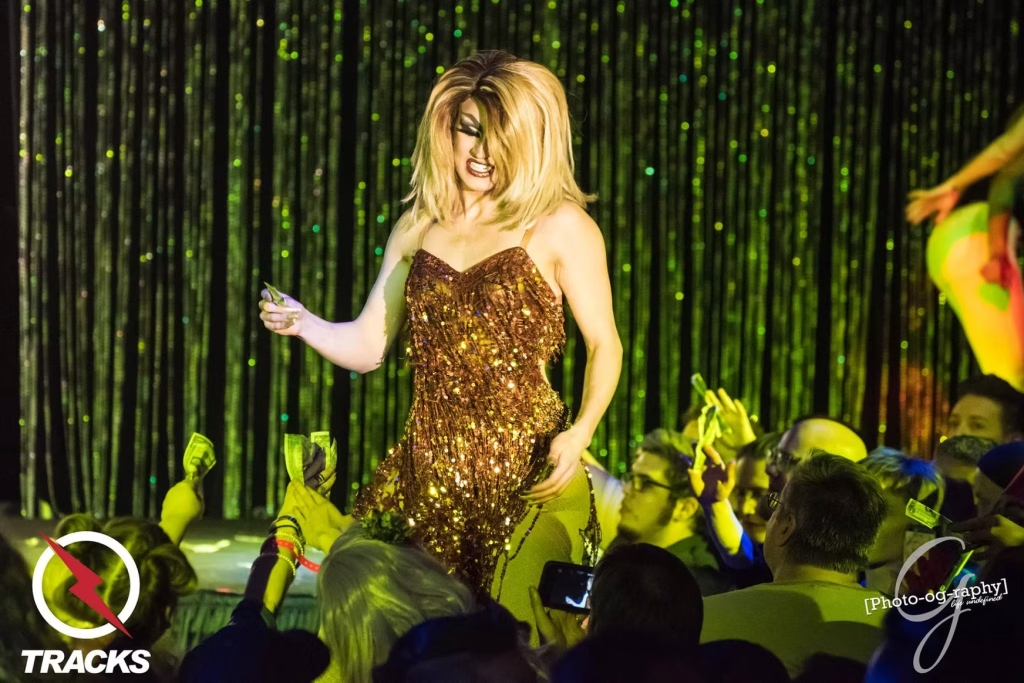
“I feel like I’m loud as it is throughout the year, but I am just so much louder, and that’s out of drag too,” said L’Whor, who also goes by Zach Sullivan. “I’m going to be queer in every space and trans in every space and non-binary in every space that I walk into.”
Amid the—albeit scary—political reality, both L’Whor and Seibert agreed that fear isn’t the way forward. Looking back to the 1980s, Seibert reflected on the joy of resisting.
“It was definitely political, but we also had an immortality, and you couldn’t imagine anything else, even if people were opposed to you. You still could go and just be, ‘Look at me. I’m proud. I’m happy. I’m gay.’ So I’ve always gone with a happiness to pride,” Seibert said. “I think we’re a little fearful (now), and so I want to make sure I’m there.”
L’Whor sees things similarly. “It is impacting us, but if you’re doing it the right way, you’re not fearing it, because when we start fearing it, we recluse. We go back in the closet,” L’Whor said. “And when we celebrate our queerness, we come together with more power.”

Seibert, for his part, is looking at the long term. As someone who has lived through various eras of LGBTQ+ acceptance, he understands what is at stake.
“Historically, just because we moved ahead for the last fifty years doesn’t mean it cannot all be taken away from us in an instant,” Seibert said. “And right now, it’s being taken away from us. It’s a real possibility, possibly a probability for the time being if we don’t fight—of going back into, you know, where we’re shunned and where we are not wanted around.”

